Commercial Facility Maintenance for Schools: A Complete Guide
Last Updated: November 14, 2026
Quick Summary
Commercial facility maintenance for schools is the coordinated delivery of preventive, routine, and corrective services that keep K-12 and higher-education buildings safe, operational, and ready for learning. The scope spans building systems such as HVAC, electrical, and plumbing, plus janitorial programs and the documentation that ties them together.
- Preventive maintenance completion rate matters as much as the plan itself.
- Build the maintenance calendar around the school year, placing heavy work in summer breaks.
- Separate the emergency work order channel from the routine request queue.
- Fund scheduled preventive work fully, since underfunding it creates next year's corrective line.
- Score bids on scope, service levels, staffing, reporting, references, transition, and price.
Table of Contents
- What Commercial Facility Maintenance Covers in Schools
- Why Preventive Maintenance for Schools Prevents Costly Failures
- Building a School Facilities Maintenance Schedule That Works
- Repairs, Emergency Response, and Work Order Management
- Understanding School Facility Maintenance Costs and Budgeting
- What a School Maintenance Service Agreement Should Include
- Choosing a Facility Maintenance Provider for Your District
- Compliance, Documentation, and Measurable KPIs
- Request a Facility Maintenance Assessment for Your Schools
- Frequently Asked Questions
What Commercial Facility Maintenance Covers in Schools
Commercial facility maintenance for schools is the coordinated delivery of preventive, routine, and corrective services that keep K-12 and higher-education buildings safe, operational, and ready for learning. Commercial facility maintenance scope typically spans building systems, cleaning programs, and the documentation that ties them together. The scope is broader than most districts assume. A single campus may run dozens of separate systems, each with its own service interval and failure mode.
Building Systems: HVAC, Electrical, and Plumbing
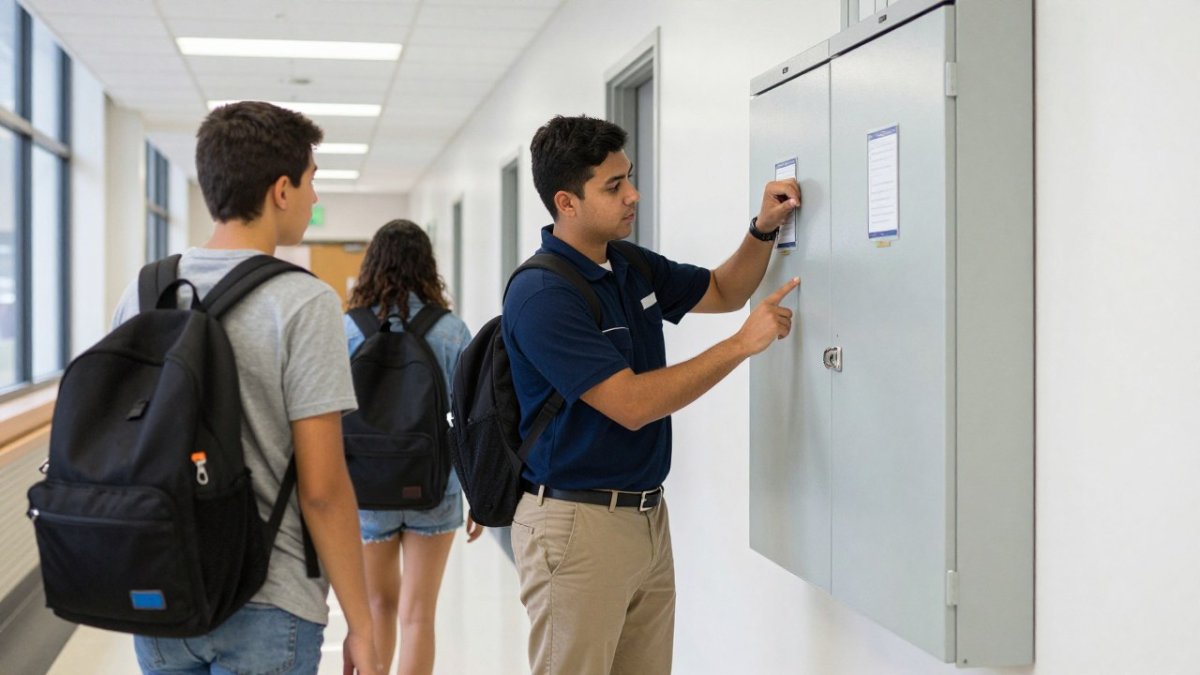
HVAC systems, electrical distribution, and plumbing form the backbone of building operations. Heating and cooling equipment drives indoor air quality and comfort, while electrical systems power everything from classroom technology to fire alarms. Plumbing failures are among the most disruptive events a school can face because water damage closes rooms fast. Ventilation performance deserves particular attention: a building that cannot move air properly undermines the learning environment regardless of how clean the floors are.
Janitorial Services and Cleaning Programs
Cleaning services split into daily, weekly, and periodic work. Daily janitorial services cover classrooms, restrooms, and high-touch surfaces. Periodic work includes floor stripping, carpet extraction, and deep disinfection during breaks. A common mistake is treating janitorial and facilities maintenance as separate contracts with separate accountability; when both report to one provider, cleaning crews flag failing fixtures before they become work orders.
Why Preventive Maintenance for Schools Prevents Costly Failures
Preventive maintenance for schools is scheduled servicing that catches degradation before it becomes a failure. The math is simple: a filter change costs a fraction of a compressor replacement, and a compressor replacement costs far less than emergency closure of a wing during the school year.
Preventive maintenance completion rate matters as much as the plan itself. A schedule that exists on paper but slips every quarter delivers little benefit.
Building a School Facilities Maintenance Schedule That Works
A school facilities maintenance schedule should organize work by frequency and season, not by whichever request arrived loudest. Here is the structure we recommend districts adopt:
| Frequency | Typical Tasks | Owner |
|---|---|---|
| Daily | Restroom cleaning, trash removal, high-touch disinfection | Janitorial staff |
| Weekly | Filter checks, playground inspection, exit light testing | Maintenance staff |
| Monthly | HVAC belt inspection, plumbing leak sweep, fire extinguisher check | Maintenance staff |
| Quarterly | Roof and gutter review, electrical panel inspection, deep floor care | Provider or in-house crew |
| Annual | Boiler service, system optimization review, asset condition audit | Provider |
Build the calendar around the school year. Heavy work belongs in summer breaks; light inspection work fits winter and spring. A schedule that ignores the academic calendar creates its own disruption.
Repairs, Emergency Response, and Work Order Management
Emergency repairs succeed or fail on response time. A school that loses heating in January needs a crew on site the same morning, not a callback in three weeks. Work orders should capture the request, the assigned technician, the response window, and the resolution, so nothing disappears into a voicemail box.
Watch out: districts that route emergencies through the same queue as routine requests consistently see slower response times. Separate the emergency channel from the routine one. For guidance on when an HVAC failure crosses into true emergency territory, see our breakdown of the signs your school's HVAC failure is a true emergency.
Understanding School Facility Maintenance Costs and Budgeting
School facility maintenance costs depend on building age, square footage, system condition, climate zone, and how much work is outsourced versus handled by in-house crews. Rather than quote a single number, a budget is commonly built from cost drivers and then benchmarked against comparable districts. The framework below is a useful starting point for districts before soliciting bids.
The Four Cost Drivers
- Building age and system vintage. Buildings older than roughly 30 years typically carry higher corrective-repair loads because major systems are at or past their expected service life.
- Square footage and building envelope. Larger footprints and older envelopes (single-pane glass, uninsulated roofs) drive both energy and repair costs. Cost per square foot is the standard normalization metric because it lets a district compare a 40,000-square-foot elementary school against a 200,000-square-foot high school.
- System condition and deferred maintenance backlog. A district carrying a large deferred-maintenance backlog will see a higher corrective share of spend until the backlog is worked down. Budgeting without acknowledging backlog produces a plan that is underfunded from day one.
- Service delivery model. Fully outsourced programs carry a management fee and vendor margin; in-house programs carry payroll, benefits, tools, and supervision overhead. Hybrid models, outsourced specialty trades with in-house janitorial, are common in K-12 because they balance control and cost.
A Three-Line Budget Model
A working budgeting model separates three lines so that one does not silently consume the others:
- Scheduled preventive work. Recurring, predictable, and the easiest line to forecast. Fund it fully; underfunding this line is what creates the corrective line next year.
- Anticipated corrective repairs. Estimate from the prior three years of work-order history, adjusted for known system end-of-life.
- Emergency reserve. Hold a contingency for failures that cannot be scheduled, boiler failure in January, roof leak after a storm, water main break. Districts that fund only the first line end up borrowing from it when the second and third arrive.
Asset Lifecycle Planning
Asset lifecycle planning belongs in the budget because replacing a system on schedule is cheaper than running it to failure. Build a simple replacement schedule from expected service life: rooftop HVAC units commonly run 15 to 20 years, boilers 20 to 30, roofs 20 to 25, and interior finishes 7 to 15 depending on traffic. When a unit approaches the end of its range, the budget should show a capital line, not just a repair line.
Benchmarking Without Quoting a Single Price
Because pricing varies by region, scope, and other factors, contact International Construction Solutions Ltd through its website for a quote. What a district can do instead is benchmark: collect cost-per-square-foot and preventive-to-corrective ratios from three to five comparable districts or from published state facilities reports, then compare its own ratios. That ratio is more useful than any single bid number.
Watch out: a budget built only from last year's actuals will repeat last year's deferred maintenance. Add a line for backlog reduction, even a small one, or the backlog compounds.
What a School Maintenance Service Agreement Should Include
A school maintenance service agreement should define scope, response times, reporting obligations, and termination terms in writing. Vague agreements produce disputes. The essentials:
- Named systems and buildings covered, with exclusions listed
- Response time commitments for routine and emergency work
- Reporting cadence and KPI definitions
- Staffing and subcontractor terms
- Insurance, bonding, and certification requirements
- Pricing structure and change-order process
- Termination and transition provisions
For a deeper walkthrough of contract terms, our guide to commercial building maintenance service agreements covers the clauses that protect both parties.
Choosing a Facility Maintenance Provider for Your District
But the answers only become comparable if the district writes a scope of work and an evaluation method before bids arrive. The process below is the one we recommend for public-school procurement.
Step 1: Write the Scope of Work First
A scope of work should list every building and system covered, the service frequency for each, and the exclusions in writing. Vague scopes produce bids that cannot be compared because each vendor prices a different assumption. Include:
- Named buildings, square footage, and system inventory (HVAC units, boilers, electrical panels, plumbing risers)
- Required service frequencies and response windows for routine and emergency work
- Reporting requirements and the data the district expects to receive
- Staffing expectations, including whether subcontractors are permitted and how they are supervised
- Insurance, bonding, licensing, and certification requirements for public projects
- Pricing structure: fixed fee, time-and-materials, or hybrid, and the change-order process
Step 2: Define Service Levels Before You Compare Bids
Service levels turn a promise into a measurable obligation. Define response and resolution windows by priority, for example, emergency (heating loss, water intrusion, electrical hazard) versus routine (a flickering light or a stuck door). Define preventive-maintenance completion expectations and the reporting cadence. Without defined service levels, a low bid and a high bid may be pricing entirely different levels of service.
Step 3: Compare Bids on More Than Price
A bid comparison should score each proposal against the same criteria: scope coverage, service-level commitments, staffing plan, reporting and KPI capability, references from comparable sites, transition plan, and price. Price is one column, not the decision.
Step 4: Evaluate the Transition Plan
What most reviews skip is transition risk. Switching providers mid-year without a documented handover leaves blind spots in service. Ask candidates how they handle the first ninety days: how they inventory assets, how they inherit open work orders, how they communicate with building staff, and how they measure whether the transition is working. A provider that cannot describe a transition plan in detail will improvise one on your campus.
Step 5: Check References and Certifications
Ask for references from comparable sites, similar building age, square footage, and service mix, and call them. Ask specifically about response time during emergencies and about reporting quality. Check certifications against the requirements of your public projects, and confirm insurance and bonding limits meet district thresholds.
Step 6: Build the Contract Around Accountability
The agreement should carry the scope, service levels, reporting obligations, KPI definitions, insurance and bonding terms, pricing and change-order process, and termination and transition provisions. For a deeper walkthrough of contract terms, our guide to commercial building maintenance service agreements covers the clauses that protect both parties.
If you are weighing how different service models compare, our comparison of City Wide alternatives for maintenance lays out the trade-offs. We also publish our facilities maintenance service offering with contract options and how to request a quote.
Compliance, Documentation, and Measurable KPIs
Compliance and documentation separate a defensible maintenance program from a hopeful one. Records should cover inspections, repairs, certifications, and safety procedures, retained in a system a district can audit. Health and safety obligations for public schools are set by federal, state, and local authorities, and districts should confirm current requirements with their state education agency.
Track a small set of KPIs consistently:
| KPI | What It Reveals |
|---|---|
| Preventive maintenance completion rate | Whether the schedule is real |
| Average response time | Emergency readiness |
| Work order backlog | Staffing and prioritization health |
| Repeat repair rate | Whether fixes actually fixed anything |
Request a Facility Maintenance Assessment for Your Schools
A facility condition assessment can help turn assumptions into a plan by inventorying school assets and producing a maintenance schedule tied to a budget. International Construction Solutions Ltd has completed 500+ projects and holds MBE, WBE, DBE, EDGE, RSB, FBE, LPE, SBE, and NMSDC certifications, with over a decade of experience serving public and private sector clients. The company delivers ongoing preventive and corrective maintenance alongside construction and renovation work. Service plans can be built around the academic calendar with reporting against measurable KPIs.
The gap between a district that reacts and one that plans shows up in operating costs, closure days, and staff burnout. International Construction Solutions Ltd provides preventive and corrective maintenance, scheduled service plans, and work order tracking built for school environments. Get started with International Construction Solutions Ltd and turn your maintenance backlog into a managed schedule. Reach our team through our contact page to request your assessment.
Frequently Asked Questions
What is commercial facility maintenance for schools?
Commercial facility maintenance for schools covers the ongoing upkeep of buildings and grounds so learning spaces stay safe and operational. It includes preventive maintenance on HVAC, electrical, and plumbing systems, routine repairs, janitorial services, and emergency response. For K-12 districts and campuses, the work also touches indoor air quality, safety procedures, and asset lifecycle planning. A well-run program tracks work orders, schedules inspections, and reports on response times so facility managers can show measurable results to administrators and boards.
How much does school facility maintenance cost?
School facility maintenance costs vary widely by building age, square footage, system condition, and service scope. A district with aging HVAC equipment and a large maintenance backlog will spend more than a newer campus with modern systems. Rather than quoting a flat rate, ask providers to break out preventive work, routine repairs, and emergency response separately. Pricing for a school maintenance service agreement depends on the number of sites, service frequency, and whether janitorial is included. Contact International Construction Solutions Ltd through its website for current pricing or a quote.
How can schools create a preventive maintenance plan?
Start by inventorying every building system and its condition, then set inspection frequencies based on manufacturer guidance and past failure history. Build a school facilities maintenance schedule that assigns seasonal tasks, such as HVAC filter changes before cooling season and roof checks before winter. Assign work orders to named staff or vendors, track completion rates, and review the plan quarterly. Include emergency procedures for heating and cooling failures so response time stays short during occupied hours.
What should a school maintenance service agreement include?
A school maintenance service agreement should define scope clearly: which buildings, which systems, and which tasks fall under preventive versus corrective maintenance. It should state response time commitments for emergencies, reporting requirements, and how work orders are tracked. Include vendor credentials such as MBE, DBE, or SBE certifications if your district requires them, plus insurance and bonding details. Clarify how change orders are priced and how the contract handles seasonal spikes, so there are no surprise costs mid-year.
How should a school choose a facility maintenance provider?
Look for a provider with documented experience in educational facilities, not just commercial property maintenance. Ask for recent project examples in your area, proof of certifications, and references from districts of similar size. Compare how each provider handles emergency repairs, reporting, and staff training. Request a walkthrough of your buildings so the proposal reflects actual conditions.
