How to Select Commercial General Contractors: A Buyer's Guide

Last Updated: November 4, 2026
Quick Summary
To select commercial general contractors, start by defining your project scope, budget, and schedule in writing. Then shortlist three to five firms with similar project experience, verify their licenses, insurance, and bonding capacity, and compare bids on identical scope.
- Write the scope in plain terms: square footage, building systems, occupancy constraints, and phasing requirements.
- Shortlist three to five firms, since more than that usually produces bid fatigue and weaker proposals.
- Verify licensing, certifications, insurance, and bonding capacity before moving from shortlist to contract.
- Compare bids on the same scope, adjusting for exclusions so the lowest total becomes meaningful.
- Have legal counsel review the contract before signing, because silence on an issue usually favors the contractor.
Table of Contents
- Defining Your Project Scope and Requirements Before You Shortlist
- Setting Budget, Schedule, and Delivery Method
- Researching and Shortlisting Commercial General Contractors
- Verifying Licenses, Certifications, Insurance, and Bonding Capacity
- Reviewing Project Experience, Portfolios, and Client References
- Commercial Contractor Red Flags to Watch For
- Questions to Ask a Commercial General Contractor Before Hiring
- Running an Apples-to-Apples Commercial Construction Bid Comparison
- Evaluating Contract Terms and Commercial Risk Allocation
- Using a Commercial Contractor Selection Checklist to Make Your Decision
- Frequently Asked Questions
Defining Your Project Scope and Requirements Before You Shortlist
How to select commercial general contractors starts with a clear project definition, not a list of names. Before you call anyone, write down what you are building, where, to what standard, and by when. A vague scope at the start is a common reason projects stall, because every contractor ends up bidding a different job.
A commercial general contractor is the firm that takes overall responsibility for delivering a building project, coordinating subcontractors, schedules, permits, and inspections. Their role is broad, so the scope you give them has to be specific enough to price fairly.
Write the scope of work in plain terms: square footage, building systems affected, occupancy constraints, and any phasing requirements. Public and healthcare clients should also list their compliance obligations up front, since these change both cost and timeline.
Watch out: a scope that lists "renovate the lobby" without drawings, finishes, or a completion date invites change orders. The gap between the lowest bid and the final invoice usually lives in those missing details.
Setting Budget, Schedule, and Delivery Method
Set a budget range and a hard completion date before you request proposals. Contractors cannot give a reliable estimate against a moving target, and you cannot compare bids fairly without a common baseline.
Delivery method matters as much as price. Common options include design-bid-build, where design is finished before bidding, and design-build, where one firm handles both design and construction. Each shifts risk differently, so pick the method your internal team can actually manage.
Build a schedule with milestones, not just an end date. Tie payments to completed phases where your contract allows it.
The article compares the two main delivery methods and how each shifts risk.
| Delivery method | How it works | Key difference |
|---|---|---|
| Design-bid-build | Design is finished before bidding | Design completed before construction bids |
| Design-build | One firm handles design and construction | Single firm owns both design and construction |
Researching and Shortlisting Commercial General Contractors
Start with contractors who have built projects similar in size, type, and complexity to yours. A firm that excels at small tenant fit-outs may not have the bonding capacity or the project management systems for a multi-million-dollar municipal job. If you are still defining scope, see whether a provider offers full-service construction management for projects of your size and type.
Check whether the contractor holds the credentials your project requires. For public work, that often includes minority- or disadvantaged-business certification (SBA business certifications: 8(a), WOSB, HUBZone, SDVOSB -Small Business Administration). Confirm the status yourself with the issuing agency rather than relying on a brochure.
Shortlist three to five firms. More than that usually produces bid fatigue and weaker proposals.
Verifying Licenses, Certifications, Insurance, and Bonding Capacity
Verify four things before shortlisting becomes contracting: licensure, certifications, insurance, and bonding capacity.
- Licensing: Confirm the contractor's state license is active and covers the trades your project needs.
- Certifications: Check any minority, women-owned, or disadvantaged-business status against the issuing agency's public records.
- Insurance: Request certificates for general liability, workers' compensation, and auto coverage, and confirm limits meet your contract requirements.
- Bonding capacity: Ask for a surety letter stating the bond amount the contractor can support. Ask which performance and payment bonds your project requires.
Financial stability belongs in this check too. A contractor who cannot carry payroll through a late payment will struggle to finish your job, so ask for recent financial statements or a banker reference.
Reviewing Project Experience, Portfolios, and Client References
Ask for a portfolio of completed projects with the same building type and a similar contract value. Then call the references. Ask whether the project finished on schedule, whether change orders were managed transparently, and whether the contractor's subcontractors showed up as promised.
Pay attention to how references describe problems. A firm that resolved an issue quickly is often a better bet than one that never had a problem anyone will admit to.
Look for evidence of responsiveness too.
Commercial Contractor Red Flags to Watch For
Some warning signs show up early and repeatedly:
- Bids far below the others with no explanation of how the price is achieved
- Reluctance to provide references or insurance certificates
- Pressure to sign before you have reviewed the contract
- No written schedule or no named project manager
- Vague answers about subcontractor selection and oversight
- Frequent mentions of "allowances" without detail
A common mistake is treating the lowest bid as the best value. An unusually low number often means missing scope, optimistic labor assumptions, or a plan to recover margin through change orders.
Questions to Ask a Commercial General Contractor Before Hiring
Prepare these questions for every finalist:
- How many projects of this size have you completed in the last three years?
- Who will be the day-to-day project manager, and how many active jobs are they running?
- How do you handle subcontractor selection and oversight?
- What is your process for change orders, and how fast do you price them?
- How do you track schedule performance, and what happens when you fall behind?
- Can you provide your current bonding capacity and recent financial references?
The answers matter less than how specific they are. Vague answers to specific questions are a signal worth noting.
Running an Apples-to-Apples Commercial Construction Bid Comparison
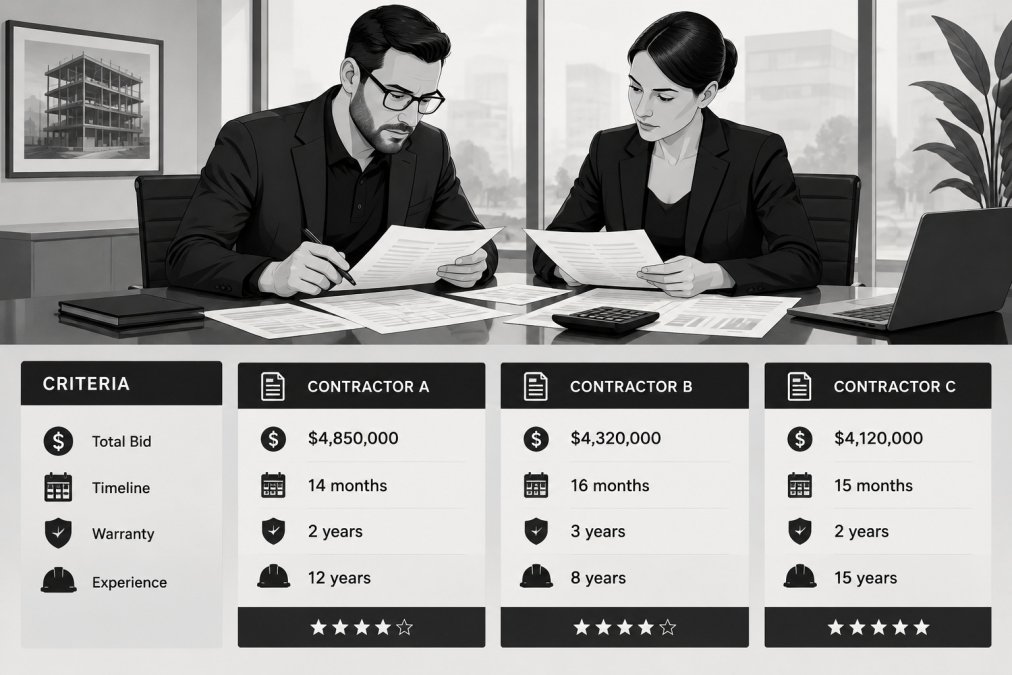
Compare bids on the same scope, not on the totals alone. Build a comparison sheet that lists each scope item, quantity, and allowance, then record what each contractor included and excluded.
Look at the same categories side by side: labor, materials, general conditions, insurance, bonds, overhead, and profit. Flag any line item that is missing or carries a different assumption. A bid that is $50,000 lower may simply have excluded the flooring.
Normalize the numbers. Adjust for exclusions by pricing them separately so each proposal reflects the full job. Only then does the lowest total become meaningful.
Evaluating Contract Terms and Commercial Risk Allocation
The contract is where a commercial general contractor selection is actually won or lost. For ongoing building care, a complete guide to maintenance service agreements covers the terms worth reviewing. The bid tells you what the contractor will charge; the contract tells you who pays when the schedule slips, the site turns out to be full of rock, steel prices jump, or the punch list drags into a second month. Most owners spend weeks comparing proposals and minutes reviewing the agreement, which is backwards. Read the contract with the same discipline you applied to the bids, and have construction counsel review it before signature.
Focus your review on the provisions that move money and risk:
- Payment terms. Confirm the billing cycle, the pay-when-paid versus pay-if-paid language, the approval period, and whether the owner can withhold payment for disputed work. A contractor who is paid monthly on approved applications of payment has a very different cash position than one paid 60 days after invoice. Check whether the contractor must provide lien waivers and affidavits with each application.
- Retainage. Confirm the retainage percentage, when it steps down, and what conditions trigger final release. Excessive retainage with no step-down can strain a contractor's cash flow and show up as slower closeout.
- Change orders. Specify who can authorize a change, the required written form, the markup allowed on subcontractor and self-performed work, and the time limit for pricing. Owners often negotiate a cap on contractor overhead and profit markups on changes. Without a written change-order procedure, verbal directives become disputes.
- Schedule and delay risk. Identify the completion date, the definition of substantial completion, and how excusable delays are handled. Liquidated damages for late completion can give the contractor a financial reason to hold the schedule, but they should be paired with a clear extension-of-time process for owner-caused or force-majeure delays. Confirm who owns the schedule and how often it must be updated.
- Indemnity and insurance. Review the indemnity clause, the additional-insured requirements, and the waiver of subrogation. Confirm the contractor's general liability, workers' compensation, auto, and umbrella limits meet your requirements and that your organization is named as an additional insured. For public and institutional work, confirm the insurance and bonding requirements match your procurement rules.
- Warranties and closeout. Check the warranty period for workmanship and equipment, the required closeout documents (as-builts, O&M manuals, attic stock, training), and the conditions for final payment. Confirm the workmanship warranty period and how equipment warranties are handled.
- Dispute resolution. Note whether disputes go to mediation, arbitration, or litigation, and whether there is a stepped negotiation process before either. Arbitration can be faster and more private but limits appeal rights; litigation is public and slower. Pick the mechanism your organization can actually manage.
- Termination. Confirm the owner's right to terminate for cause and for convenience, the notice and cure periods, and how the contractor is paid on a convenience termination. A convenience-termination clause that pays only for work performed, with no demobilization or overhead recovery, is a risk the contractor will price into the bid.
Risk allocation is a negotiation, not a formality. A contractor who accepts unlimited liquidated damages, broad indemnity for the owner's own negligence, and a pay-if-paid clause with no cap is either mispricing the risk or planning to recover it through change orders. A balanced agreement assigns each risk to the party best able to control it: the contractor controls means and methods, schedule execution, and subcontractor performance; the owner controls site access, design decisions, and timely payment.
Watch out: a contract that is silent on an issue is not neutral. Silence on unforeseen site conditions usually means the contractor will claim a change order, and silence on material price escalation usually means the owner absorbs the increase. Fill the gaps in writing before award rather than negotiating after the first dispute.
Have legal counsel review the agreement before signing, and budget for that review in your procurement timeline. A short review costs far less than a dispute over an ambiguous clause, and it gives your team a clear record of the risk decisions you made and why.
Using a Commercial Contractor Selection Checklist to Make Your Decision
Score each finalist against the same criteria: relevant experience, credentials, bonding and insurance, financial stability, references, communication, and bid completeness. Assign weights based on your project's priorities, then total the scores.
Use the checklist to document your decision. A written rationale protects you in public procurement and gives your internal team a clear record of why a contractor was selected.
Once you have selected a contractor, the work does not end. If ongoing care is part of your decision, you can compare facilities maintenance contract options with daily, weekly, and bi-weekly schedules and request a quote. Set measurable performance indicators for schedule, budget variance, and safety incidents, and review them monthly. If you need help defining scope or comparing proposals, contact International Construction Solutions Ltd to discuss your project.
Frequently Asked Questions
How do I choose a commercial general contractor?
Start by defining your project scope, budget, schedule, and delivery method. Then shortlist firms with proven experience on projects of similar size and complexity, verify licenses, insurance, and bonding capacity, and check references from recent clients. Compare bids on identical scope assumptions rather than on the lowest total alone. A structured evaluation across experience, financial stability, communication, and safety record usually reveals which contractor fits your project best.
What red flags should I watch for when hiring a general contractor?
Watch for bids far below the others, which often signal missing scope or future change orders. Be cautious of contractors who resist providing references, proof of insurance, or bonding documentation. Vague proposals with no detailed schedule, unclear payment terms, or pressure to sign quickly are also warning signs. Confirm the license and insurance status directly with the issuing agency or carrier before signing.
Should I pay a contractor 50% upfront?
Large upfront payments create risk, so most commercial owners tie payments to verified progress and materials delivered. Payment schedules should be written into the contract, with retainage held until substantial completion and lien waivers collected with each draw. If a contractor requires a large deposit, ask why and confirm how funds will be used and protected.
What should a commercial construction contract include?
A solid commercial construction contract defines the scope of work, project schedule with milestones, payment terms and retainage, change order procedures, insurance and bonding requirements, and warranty obligations. It should also specify how disputes are resolved and how liability for delays is allocated. Have legal counsel review the document before signing, especially for public projects with specific statutory requirements.
How can I compare commercial contractor bids fairly?
Require every bidder to price the same drawings, specifications, and scope assumptions. Build a comparison sheet that lists labor, materials, subcontractor costs, general conditions, overhead, profit, and contingency separately. Note exclusions, allowances, and alternates for each bid. Normalizing bids this way makes price differences meaningful and highlights where a low number is missing scope.
How do I verify a general contractor's license, insurance, and references?
Look up the license with your state or local licensing board and confirm it is active and covers the trade work you need. Request current certificates of insurance directly from the carrier, including general liability and workers' compensation. Call at least three recent clients from projects of similar size and ask about schedule performance, budget control, and how change orders were handled.
